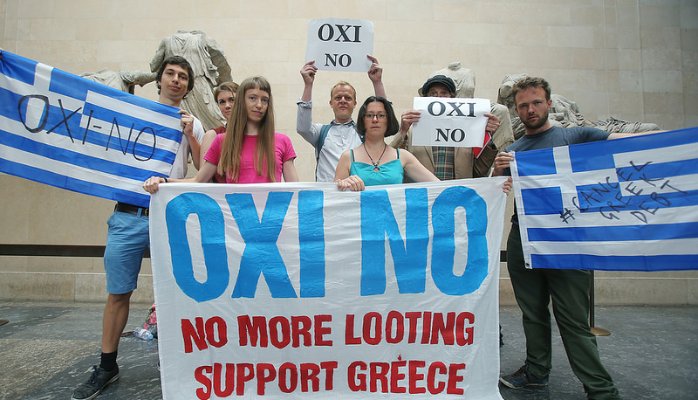
Greece is at a pivotal point in its history. It has run up huge obligations which it is unable to pay and wants a bail out from its creditors and those creditors are balking at the cost.
In my opinion, the real issues which are bothering Greece’s creditors have largely been ignored by the news media. What the band of creditors really cares about is whether Greece would be able to repay its obligations in the future. The figure they are looking to evaluate the answer to that question is not just Greece’s external debt but also its internal debt. Even if the external debt was reduced, if the internal debt obligation remains unchanged, Greece will probably default again.
Who are these internal creditors? The Greek government has a pension liability probably in the region of Euros 800 billion+ which comprises of the social security pension scheme and the government employer pension scheme. Unless the Greek government gets serious about reforming the pension system, any bailout will only be a short term band aid on its trillion dollar debt problem. From a creditors point of view, they should be hopping mad. Why should external creditors take a haircut when the Greek government does not want any internal creditors to take a write-down?
In the years prior to Greece joining the Eurozone, Greek interest rates were much higher than German rates. Consumer lending was non-existent and Greeks did not have credit cards or mortgage loans. Greece had every reason to want to drop the Drachma and adopt the Euro. To do this, they needed to meet certain national targets. In particular, any country which wanted to be a part of the Euro zone needed to show deficits below 3 percent of GDP and inflation at low levels. In 2000, Greece hit the targets needed for membership but they did so by cooking their books. Since there was no independent statistical service, the politicians simply reported any number they could get away with.
The benefits to Greece of adopting the Euro were tremendous. All Greek debt now had a European guarantee. Greeks could borrow at roughly the same rate as Germany even though they had none of the financial discipline. And borrow and spend they did. But this party came to a rude halt in 2009 when the Vatopaidi scandal caused the government of Prime Minister Kostas Karamanlis to fall and the government of George Papandreou to take over. The new government decided to play honest and announced that the deficits were much larger than what had been reported in the past. The whole situation blew up thereafter.
The problems are many fold. Greece with its 11 million citizens has a bloated public sector wherein the average government job pays three times or more of the average private sector job. The public sector is thoroughly corrupt and inefficient. Tax collection is a mess. The problem is typically cultural and it extends beyond Greece. The fiscally undisciplined countries which are all in trouble i.e., Greece, Spain, Portugal, Italy etc. are all Southern European countries. Ranged against them are the fiscally disciplined Northern European countries lead by Germany.
Germany also does not want to start a trend. If it forgives Greek debt, it will create precedence for all other debtor countries which are watching very closely which way the ball rolls. If Germany is soft with Greece, it will also have to be soft with Spain, Italy etc. (and for political reasons I will not even say France.)
Germany has a lot of political capital invested in the Eurozone. It rightly so understands the business advantages of monetary union but is probably in tears over the profligacy of the Southerners. The Germans saw the effects of hyperinflation in the years after the First World War. Its politicians made an implicit promise to the German people that it would not bail out other countries when it was time for the Germans to give up their precious Deutche Mark for the Euro. Given the history and cultural differences involved, I don’t see how a Germany politician can ask the German people to pay taxes to support Greek pensions in full without the German politician being thrown out of power. From my perspective the problem was never forgiving the debt (it can’t be repaid in any case) but the huge outcry that would result in Germany if the debt was forgiven without any of the hurt being shared by the borrowers.
Germany will come through and support Greece if Greece gets serious about pension reform but the results of the Greek national referendum probably closed that option.
So what are the implications of all the above on a Grexit?
Greece should never have joined the Eurozone in the first place. It did not qualify to join to begin with and even during the 15 years it was a member, it never achieved the financial discipline required to remain a member.
In the current situation, I think that a stalemate will happen where Greece will not submit a proposal seriously committing to pension reforms.
Due to its wartime past, Germany cannot afford to be seen as a bully which kicks Greece out of the Eurozone. Thus Germany will continue saying that it is Greece which has to submit a proposal which makes sense (i.e. cut pensions) in order for them to stay in the Eurozone. The Syriza party led by Prime Minister Tsipras will never submit to concessions which the Greeks think are unjust.
The end result is that all sides will be able to blame each other. Politics as usual will triumph. Greece will exit. The Drachma will be reintroduced. Pension obligations will be redenominated in drachmas which will plunge in value. Greece will inflate its way out of its pension mess. With Greece exiting, its creditors will probably breathe a sigh of relief and give the Greeks a break on their debt obligations.
In all this, I feel the saddest for all the Greek people who lives have been hurt and will continue to be hurt in the process. There is a huge cost in human misery and suffering when economies unravel.
How do you fix the problem so it does not happen again? Everything is fixable if people want to fix it. The formation of the Eurozone itself was completely flawed from one aspect. Countries had to achieve a fiscal target to join the Eurozone but there was no mechanism put in place to deal with a situation wherein that same country consistently forgot to maintain fiscal discipline.
I think that if the Eurozone members create an “Exit Policy” where non-performing countries know that they will be asked to leave the Eurozone if they do not keep their books balanced. The horrific economic and political implications of such a forced exit will be all the motivation necessary for the politicians to keep their economic houses in order.
Corollary: my personal view is that Greece should bite the bullet and exit the Eurozone until it truly puts its house in order. Reintroducing the Drachma will give Greece the monetary tools to reboot its economy. This will involve a huge amount of short term suffering but in the end is the only way to avoid years and years of living in debt purgatory.
Photo Credit: DropTheDebt